Enterprise Wi-Fi & RF
Wireless Solution
Surveyed, not guessed. Wi-Fi 6E and Wi-Fi 7 designs, point-to-point links and in-building cellular that hold up when the room is full.
Overview
Coverage is easy. Capacity is the hard part.
Almost any access point will show full bars in an empty room. The test is two hundred people in that room, each with two devices, all pulling video. That is a capacity and RF design problem, and it is where consumer-grade gear and eyeballed AP placement fall apart.
We design wireless from measurements. A predictive model against your floor plans and wall construction sets the initial AP count and placement; an on-site survey validates it against real signal, real interference and real building materials. After installation we survey again to prove the delivered network matches the design.
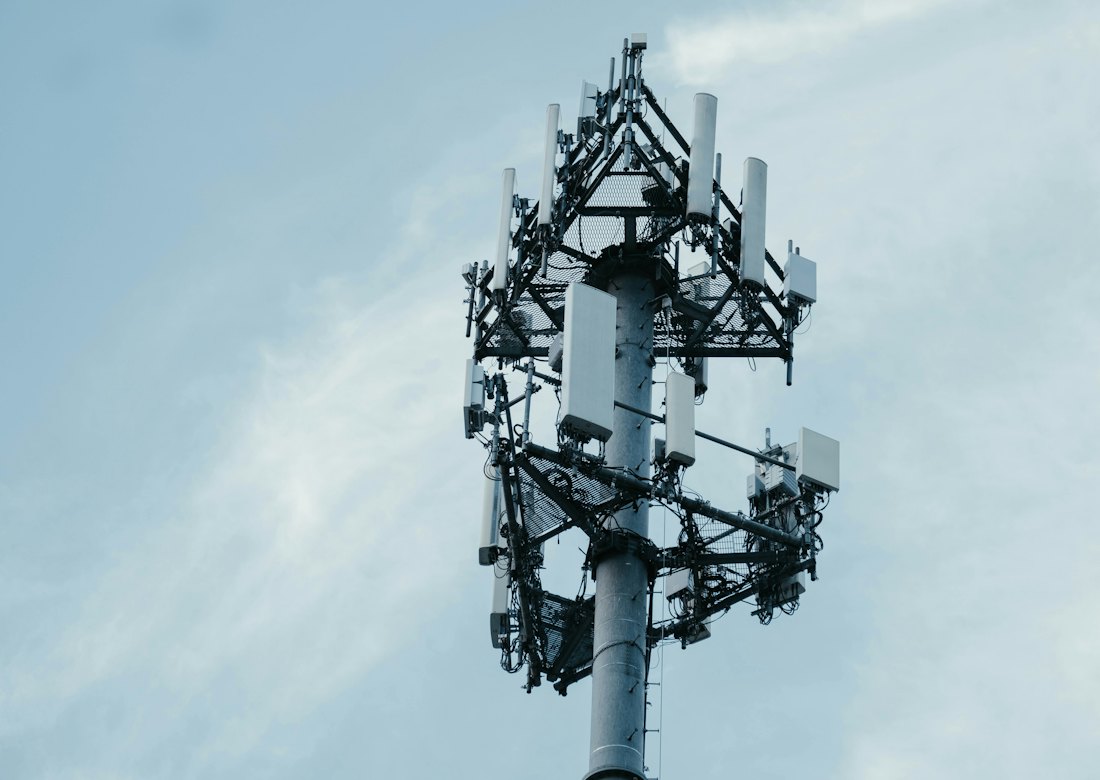
Beyond Wi-Fi, we build the rest of the wireless picture: point-to-point bridges between buildings where trenching fiber is not practical, outdoor and warehouse coverage, and distributed antenna or signal-boosting systems where cellular does not penetrate the structure.
Where we deploy it
- Warehouses
- Schools
- Hotels & MDU
- Manufacturing
- Healthcare
- Stadiums & venues
- Corporate campuses
- Outdoor yards
Talk to an estimator
Send us drawings, a device count, or just the square footage, and we’ll tell you what the scope realistically looks like.
Capabilities
What this service actually includes.
Not a category heading, but the specific work we self-perform under it.
RF site surveys
Predictive modeling from floor plans, active and passive on-site surveys, spectrum analysis to find interference, and post-install validation surveys with heat maps you keep.
Wi-Fi 6 / 6E / 7 deployment
Access point mounting, antenna selection and orientation, controller or cloud configuration, SSID and VLAN design, band steering, roaming tuning and channel planning.
High-density venues
Directional and stadium antennas, tight cell sizing, airtime fairness and per-client limits for auditoriums, gymnasiums, conference centers, houses of worship and event spaces.
Point-to-point & mesh
Licensed and unlicensed PtP and PtMP links between buildings, across yards and over obstacles, with aligned dish mounting, path survey and weatherproofed terminations.
Outdoor & industrial
IP67 hardened access points, yard and dock coverage, cold-storage and freezer deployments, forklift and scanner roaming, parking structures and campus outdoor Wi-Fi.
Cellular & DAS
In-building cellular signal boosters and distributed antenna systems for basements, stairwells, elevators, parking decks and steel-and-concrete structures that block carrier signal.
Specification
How we decide what to specify.
The reference table our estimators and engineers work from when scoping this service.
| Environment | Design driver | What we do differently |
|---|---|---|
| Open office | Client density and roaming | Smaller cells, lower TX power, tuned roaming thresholds |
| Warehouse | Height, racking, scanner roaming | Directional antennas, aisle-aware placement, seamless roam |
| School / campus | Per-room capacity at bell times | One AP per classroom, 6 GHz for capacity |
| Hotel / MDU | Per-unit coverage through walls | In-room or hallway APs, per-unit SSID isolation |
| Auditorium / venue | Hundreds of devices, one space | Under-seat or directional overhead, tight cells |
| Outdoor yard | Distance, weather, obstructions | Hardened APs, sector antennas, surge protection |
Close-out
What you receive when we’re done.
Documentation is part of the scope, not a favor. Every wireless solution project closes out with the same package, so the next person to touch the system, whether that is us or somebody else, can work from facts.
- Pre-deployment predictive design with AP placement plan
- Post-install validation survey and signal heat maps
- Channel and power plan documented per access point
- SSID, VLAN and guest portal configuration record
- Throughput and roaming test results at sampled locations
- Spectrum report flagging any interference sources found
FAQ
Wireless Solution: common questions
For anything past a handful of access points, yes. A survey is a small fraction of project cost and it prevents the two expensive failure modes: too few APs, which means dead zones, and too many APs on overlapping channels, which means they interfere with each other. Both get fixed by re-doing the work.
If you have density problems, yes: the 6 GHz band is wide, clean and largely free of legacy clients, which is exactly what crowded environments need. If your building is sparse and your clients are older devices, well-tuned Wi-Fi 6 delivers most of the benefit for less money.
No, and anyone who says otherwise is selling something. Every access point needs a cable for data and power, and Wi-Fi 6E/7 APs increasingly want Cat6A and higher-wattage PoE. Good wireless rests on good cabling.
In most cases, yes. A point-to-point wireless bridge with clear line of sight can carry gigabit-class throughput across a campus or a highway for a fraction of the cost of boring fiber. We run a path survey first to confirm line of sight and Fresnel clearance.
Related
Pairs well with
These disciplines share pathways, power and closets. Bundling them saves a mobilization.
Free estimate · No obligation
Let’s scope your project.
Tell us what the building has to do. We’ll walk the site, design the system around it and give you a written estimate with no line items you can’t explain.
- Site survey before we quote, not after
- Written scope so you can compare bids honestly
- One accountable contractor across every low voltage trade
Mon–Fri 9:00am–5:00pm ET · HQ in Doraville, GA · Crews nationwide