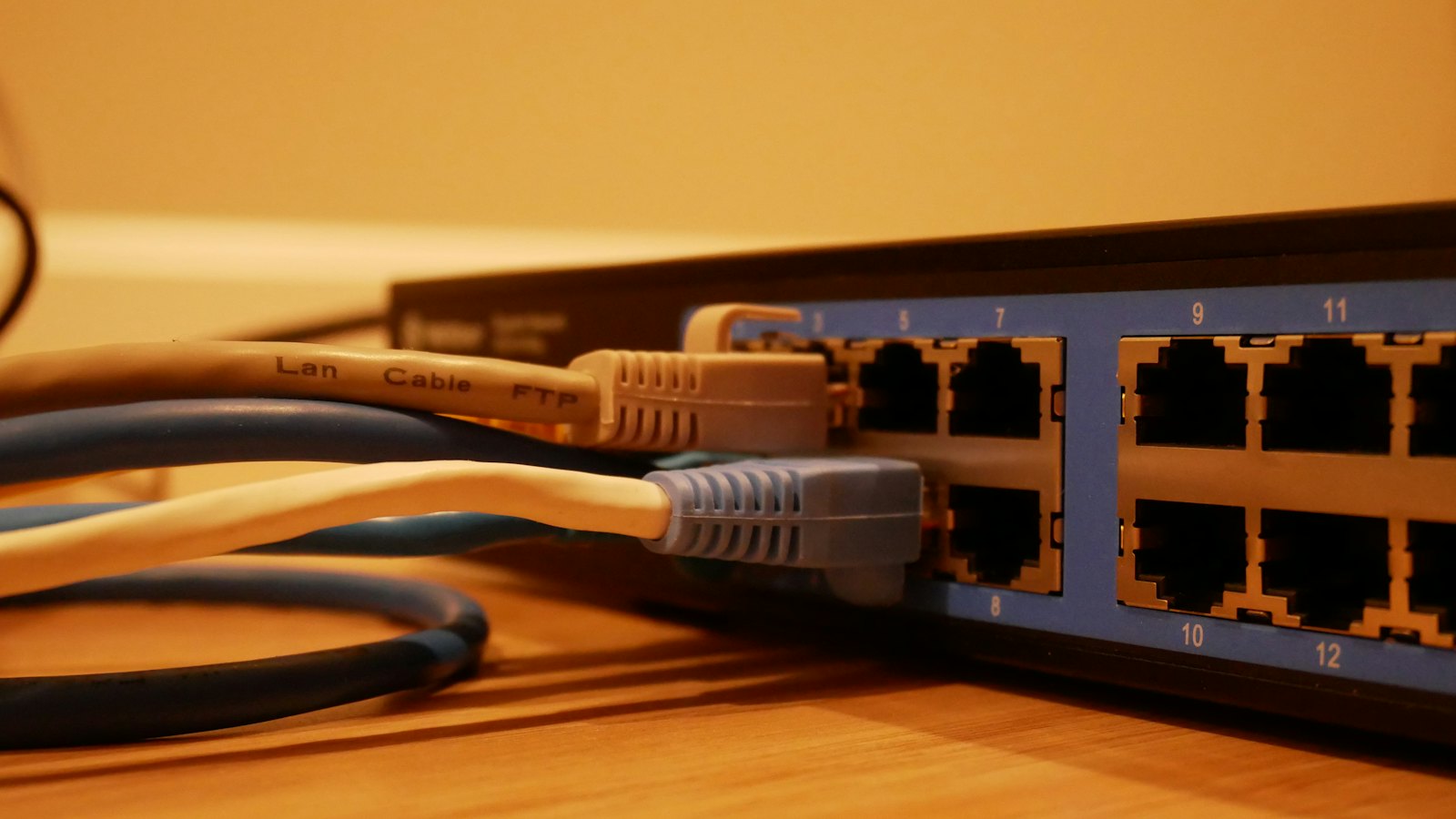
Structured Cabling Systems
Network Cabling
Copper and fiber backbones engineered to standard, tested to spec, and documented so the next technician knows exactly what they are looking at.
Overview
The layer everything else depends on
Every camera, access reader, wireless access point, phone and server in your building terminates somewhere. When that cabling plant is improvised (unlabeled, over-bent, run beside power, or pulled past its rating), the symptoms surface everywhere else as dropped packets, failing PoE devices and intermittent faults nobody can trace.
Wiscom designs and installs structured cabling as a permanent building system. We pull to TIA-568 and NEC requirements, maintain bend radius and separation from electrical, terminate to manufacturer spec, and certify every link with a calibrated tester. You get the test results, not just our word for it.
We work in occupied buildings and on active construction sites alike, from a twelve-drop tenant fit-out to a multi-building campus backbone coordinated against the GC’s schedule.
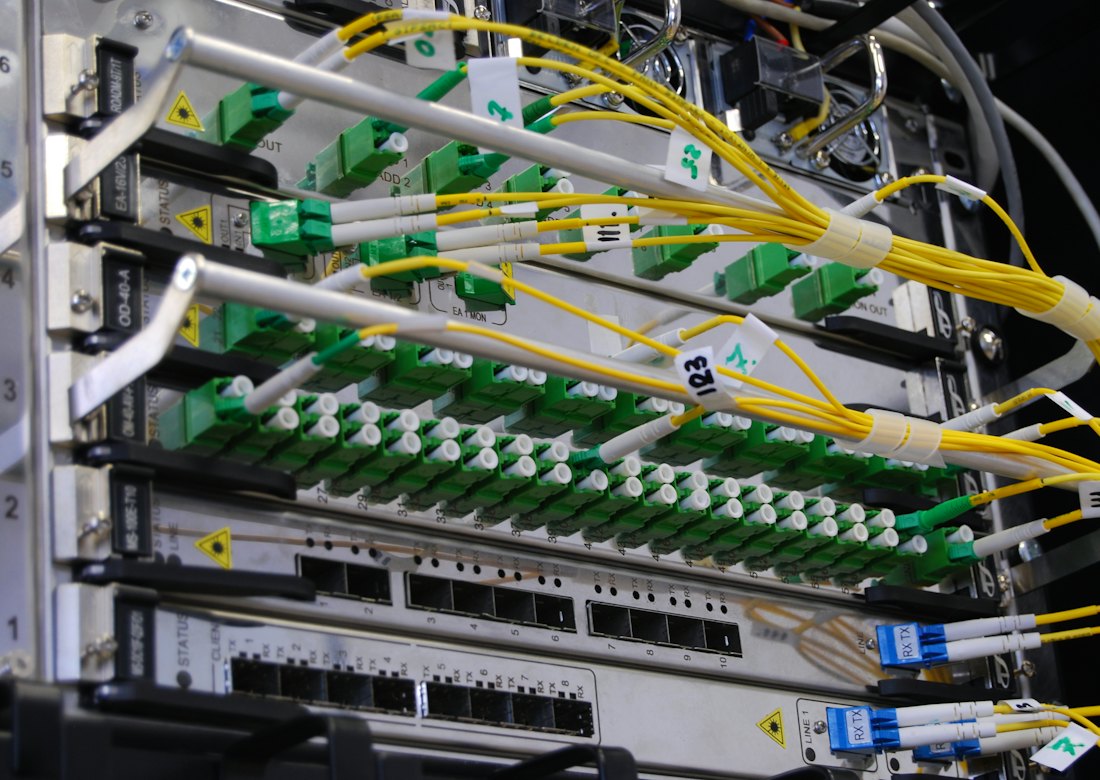
Where we deploy it
- Tenant fit-outs
- New construction rough-in
- Office remodels
- Warehouse & distribution
- Multi-family MDU
- Campus backbones
- Data center cabling
- Retail rollouts
Talk to an estimator
Send us drawings, a device count, or just the square footage, and we’ll tell you what the scope realistically looks like.
Capabilities
What this service actually includes.
Not a category heading, but the specific work we self-perform under it.
Copper structured cabling
Cat5e, Cat6, Cat6A and Cat8 horizontal runs for data, PoE cameras, access control, wireless and VoIP. Shielded and plenum-rated where the environment or code calls for it.
Fiber optic infrastructure
Single-mode and multimode (OM3/OM4/OM5) backbone, riser and inter-building runs. Fusion splicing, pre-terminated trunks, LC/SC/MPO termination, and armored or direct-burial outside plant.
MDF & IDF build-outs
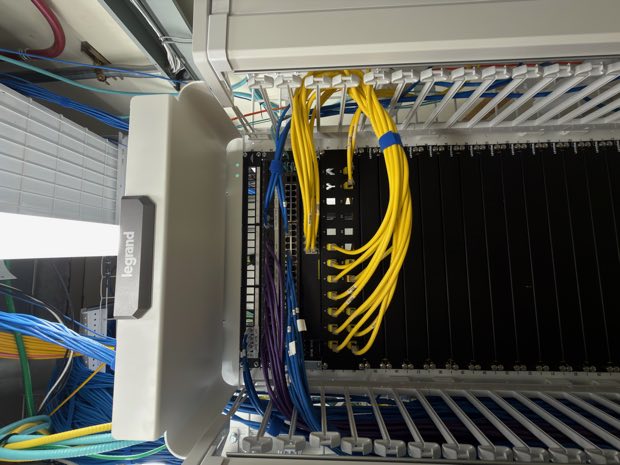
Complete telecom room construction: racks and cabinets, patch panels, vertical and horizontal cable management, ladder rack, plywood backboards, grounding bus bars and room-level labeling.
Certification testing
Every permanent link tested with a Fluke-class certifier for wire map, length, insertion loss, NEXT, return loss and delay skew. Fiber tested by OTDR and light source/power meter.
Pathways & support
J-hooks, cable tray, basket tray, conduit, sleeves, core drilling and firestopping through rated assemblies, so cable is supported every four to five feet, not draped on ceiling grid.
As-built documentation
Labeled faceplates and panels to ANSI/TIA-606, port-to-port schedules, rack elevations, floor-plan drop maps and the full certification report handed over as a digital close-out package.
On site
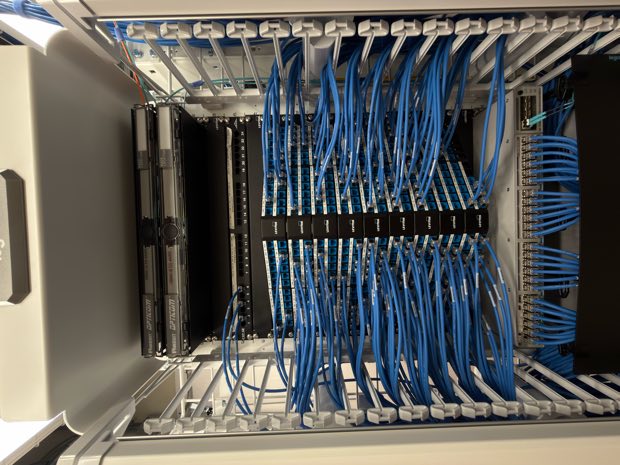
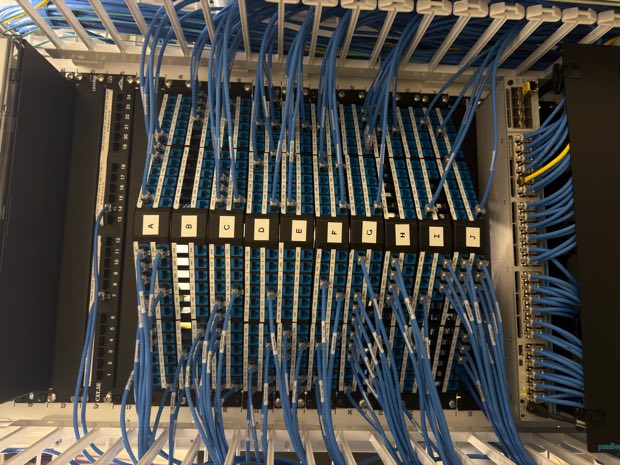
Our own work, photographed.
Not stock imagery. These are Wiscom installations.
Specification
How we decide what to specify.
The reference table our estimators and engineers work from when scoping this service.
| Media | Typical use | Bandwidth / reach | Where we specify it |
|---|---|---|---|
| Cat5e | Voice, legacy data, low-draw devices | 1 Gbps to 100 m | Retrofits and budget-driven remodels where existing pathways stay |
| Cat6 | General workstation and Wi-Fi drops | 1 Gbps to 100 m · 10 Gbps to 55 m | The default horizontal cable for most commercial fit-outs |
| Cat6A | Wi-Fi 6E/7 APs, 4K cameras, PoE++ | 10 Gbps to 100 m | New construction, high-PoE devices, anything intended to last |
| Cat8 | Top-of-rack and switch-to-switch | 25–40 Gbps to 30 m | Data center and server room short-reach links |
| OM4 multimode | Building and floor backbone | 10–100 Gbps to 150 m+ | Riser and inter-floor uplinks in mid-size facilities |
| OS2 single-mode | Campus and outside plant | 10–400 Gbps, kilometers | Building-to-building, long campus runs, carrier hand-off |
Close-out
What you receive when we’re done.
Documentation is part of the scope, not a favor. Every network cabling project closes out with the same package, so the next person to touch the system, whether that is us or somebody else, can work from facts.
- Signed certification report for every copper and fiber link
- ANSI/TIA-606 labeling on both ends of every cable
- Rack elevation and patch panel port schedule
- Floor plan marked with every drop location and ID
- Manufacturer warranty registration where applicable
- Punch walk and owner sign-off before demobilization
FAQ
Network Cabling: common questions
If the building is new construction or the walls are already open, we almost always recommend Cat6A. It supports 10 Gbps across a full 100 m channel and handles the heat of 90 W PoE++ far better, which matters as cameras, access points and displays keep drawing more power. Cat6 remains a sound choice for cost-sensitive remodels where the pathway is difficult and the device load is modest.
We certify. A continuity tester only proves the eight conductors reach the far end in the right order. Certification measures insertion loss, NEXT, return loss, propagation delay and length against the category standard, and produces a pass/fail report per link that we hand over with the project.
Yes. Most of our remodel work happens around a live business. We schedule noisy and disruptive work after hours or overnight, protect finishes, contain dust, and cut over in planned windows so staff arrive to a working network.
We can, and in many jurisdictions the NEC requires it, because abandoned cable is a fuel load in the plenum. We quote demo and removal as a line item so you can see the cost separately.
Related
Pairs well with
These disciplines share pathways, power and closets. Bundling them saves a mobilization.
Free estimate · No obligation
Let’s scope your project.
Tell us what the building has to do. We’ll walk the site, design the system around it and give you a written estimate with no line items you can’t explain.
- Site survey before we quote, not after
- Written scope so you can compare bids honestly
- One accountable contractor across every low voltage trade
Mon–Fri 9:00am–5:00pm ET · HQ in Doraville, GA · Crews nationwide